Why monsters? A living purpose statement.
In which I explore monstrosity, questions, and tiny prehistoric teeth.

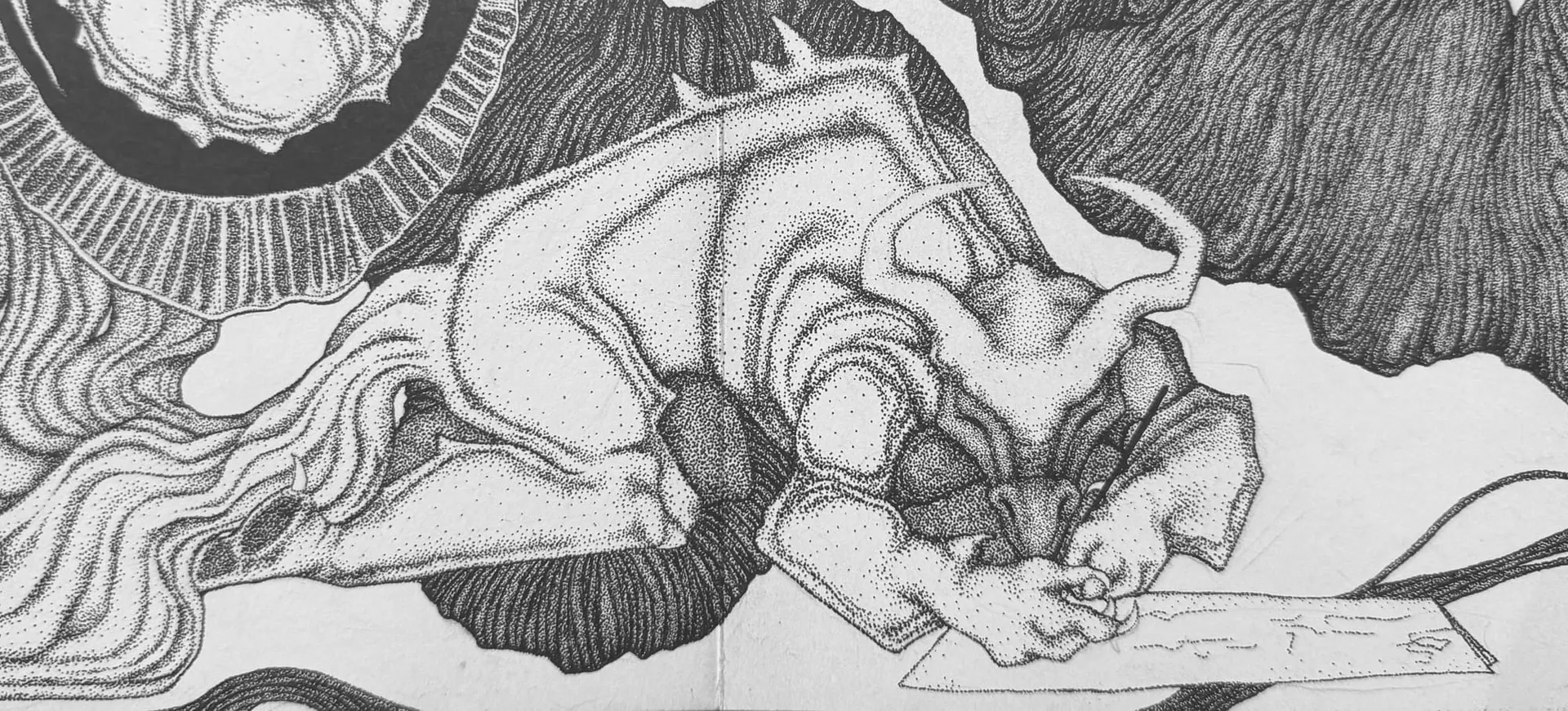
Let’s talk about monsters. I live and work with them; they’re the heart, the bone, the marrow of my work. Everything I do—from artwork to stories, essays to research projects, notes to futures programming—is, in one way or another, a lifelong conversation with monsters.
While I get a little thrill from calling myself a monster theorist, I’m not so much a scholar as I am a creative whose projects are steeped in the intellectual,c until its flavor is dark and deep like the tea I drink while I work. Work that changes form like the xenomorph in Alien (Scott, 1979), adapting to its environment, growing more attuned with each iteration. Work that invites in the monsters so we can examine ourselves and the world(s) we build with a bit more curiosity.
“There are no monsters but all of them are real. […] Monsters are the work of the imagination. [...] Monsters are ideas that show us things.” (Davies 2025, 2)
Historian Surekha Davies describes monsters as conceptual entities that wouldn’t exist without us. Whether we know it or not, we are in constant dialogue with monsters: with category busters that make us question the world and identities and values and norms we inhabit. Monsters are situated (Haraway, 1991) in our contexts, histories, and times. Monstrosity depends on when and where and who and how. Monsters are created as we live; we keep our monsters alive through stories and sensations. As scholar Jack Halberstam writes: “Monsters […] represent in their very form the game of reading and writing, rewriting and telling, telling and interpreting.” (Halberstam 2006, 34)
Monsters are spooky, terrifying, sometimes comforting, invitations to question, and question, and question. Where are the limits of us? What do we define as normal, acceptable? Why are we afraid of things we can’t define, categorize, or explain away?
This is why I study, paint, write about, and live with monsters. They are sites of imagination and (im)possibility. They ask us where we end and monsters begin, and if we need to make that separation at all.
Three questions that haunt my work:
First, what’s your favorite monster?
I love to hate this question. I can’t pick favorites. While I’m partial to a vampire, a shapeshifter, a hybrid, a cyborg, my favorite part about monsters is their monstrosity and ability to call our reality into question.
Second, what’s monster theory?
There’s backstory. It’s summer 2021, picture me in my early twenties, more like a non-cannibalistic Baba Yaga than your typical young adult. Picture me clawing my way out of the pandemic and into my higher education. Into something called critical theory. Despite this philosophy revolving around critique and power and praxis, pulling together almost all of my lifelong interests, something was missing. I found that something tucked in Ebony Elizabeth Thomas’ The Dark Fantastic, on page twenty, I saw the words monster and theory used together for the first time. I was hooked.
Monster theory is a branch on the critical theory tree. It’s about learning what makes us (people, cultures, systems) tick through the monsters we create (Cohen 2020, 37). It’s a way of asking why, why this way? The term itself could be my sibling; it’s as old as my parents’ marriage. In 1996, scholar Jeffrey Jerome Cohen published “Monster Culture (Seven Theses)” in which he described monsters as cultural bodies, ones that we shape as much as they shape us, ones that meld our fears with our desires, ones that invite us into a process of imagining and sewing together fragments of the world(s) we create.
“[M]onsters ask us how we perceive the world, […] They ask us to reevaluate our cultural assumptions about race, gender, sexuality, our perception of difference, our tolerance toward its expression. They ask us why we have created them.” (Cohen 2020, 52)
“They ask us why we have created them.” This is my why. Monsters exist because we socially, psychologically, linguistically, categorically make them. Our bodies react in fear to something that all at once doesn’t exist and couldn’t exist without us. With monsters, I can meld problems of perception, epistemology, queer theory, disability studies, scientific knowledge, and futures into a hybrid body that can connect to your body.
Monsters begin as instinctual things and translate into story and theory and re-articulate back into our embodied knowledge because of the reactions we have to them. The fear, camp, grotesqueness, unexpectedness, maybe even sexiness, they instill, force us into embodied presence with them, with ourselves, and the worlds we create. Monsters make the theoretical tangible as they hold theories and entire cultures, lineages, and traditions in their (or rather, our) bodies.
And third (the question that haunts me), how do you practice monster theory?
It starts with my body. I was born into a bodymind (Walker, 2021) that coped with living in a world that didn’t accommodate her by imagining faeries and imps and fantastic creatures living at the edges of it. Monsters were always inevitable. I knew monsters in my bones before I learned them in theory. It’s a process my work reflects, it’s creative before it’s scholarly; it’s about making theory accessible before it’s about expanding an academic canon. My work is petulant, playful, and all about exploring monstrosity from a personally embodied perspective.
Through my work, I practice monster theory the way paleontologists collect tiny teeth. A method I learned about in 2014 down in the University of Michigan’s Museum of Natural History’s recently flooded and particularly musty basement. My sister Sonja and I were there for her research project, Sunny and the Elk. We met Phil Myers and Dan Fisher to discuss how we could research and test bones she’d recently unearthed. After our meeting, they took us down behind locked doors to explore shelves and tables and piles of bones, from gargantuan mammoth skulls to the tiniest of ancient ungulate teeth. They described how paleontology students collected these teeth by laying belly-down near ant hills. With magnifying glasses and tweezers in hand, they’d pluck the tiny teeth from the ants who would bring them up from the depths of their nest.
I am belly down, peering into books and theories and resources and movies and embodied experiences. I’m tweezing these little teeth and turning them into an ontology of what I know monster theory to be as a bit of a categorical monster myself, living at the intersection of autism, queerness, and invisible disability. This ontology exists in every piece of art I paint, every note I make, every essay I write, every story I create, every piece of futures programming, and every conversation I have.
As I collect these metaphorical teeth, I’m crafting an education and career that is patchworked together like Frankenstein’s monster. As I collect these metaphorical teeth, I am not claiming to be an expert in monster theory, or any philosophy or concepts I research, write about, or illustrate, unless, of course, it’s tacit knowledge/personal epistemologies (Kidd et al., 2019). Instead, everything I weave together is a reminder of the gaps in knowledge, the little teeth lost to human eyes through the natural order of time and ant hills. And these gaps are the places where our monsters wriggle, tear, slither (and other monster-y verbs) through so they can haunt and spook and ask us why.
-- Last updated: September 16, 2026
References:
Alien. Directed by Ridley Scott, performances by Sigourney Weaver, Tom Skerritt, and John Hurt, 20th Century Fox, 1979.
- Note: Xenomorph is the official term for the alien in the Alien franchise, it means, essentially, strange shape. However, the term isn’t used in the film itself, becoming associated with the alien later on.
Cohen, Jeffrey Jerome. “Monster Culture (Seven Theses).” The Monster Theory Reader, edited by Jeffrey Andrew Weinstock, University of Minnesota Press, 2020, pp. 37–56. (WorldCat /Bookshop)
Davies, Surekha. Humans: A Monstrous History. University of California Press, 2025. (WorldCat /Bookshop)
Halberstam, Jack. Skin Shows: Gothic Horror and the Technology of Monsters. Duke Univ. Press, 2006. (WorldCat / Bookshop)
Haraway, Donna Jeanne. “Situated Knowledges.” Simians, Cyborgs, and Women: The Reinvention of Nature. Routledge, 1991. (WorldCat / Bookshop)
Kidd, Ian James, et al., editors. The Routledge Handbook of Epistemic Injustice. First issued in paperback, Routledge, Taylor & Francis Group, 2019. Routledge Handbooks in Philosophy. (WorldCat / Bookshop)
Thomas, Ebony Elizabeth. The Dark Fantastic: Race and the Imagination from Harry Potter to The Hunger Games. New York University Press, 2019. (WorldCat / Bookshop)
Walker, Nick. Neuroqueer Heresies: Notes on the Neurodiversity Paradigm, Autistic Empowerment, and Postnormal Possibilities. Autonomous Press, 2021. (WorldCat / Bookshop)
- Note: Walker uses the term bodymind to focus on the fact that neurodiversity is part of our brains and nervous systems, body+mind.
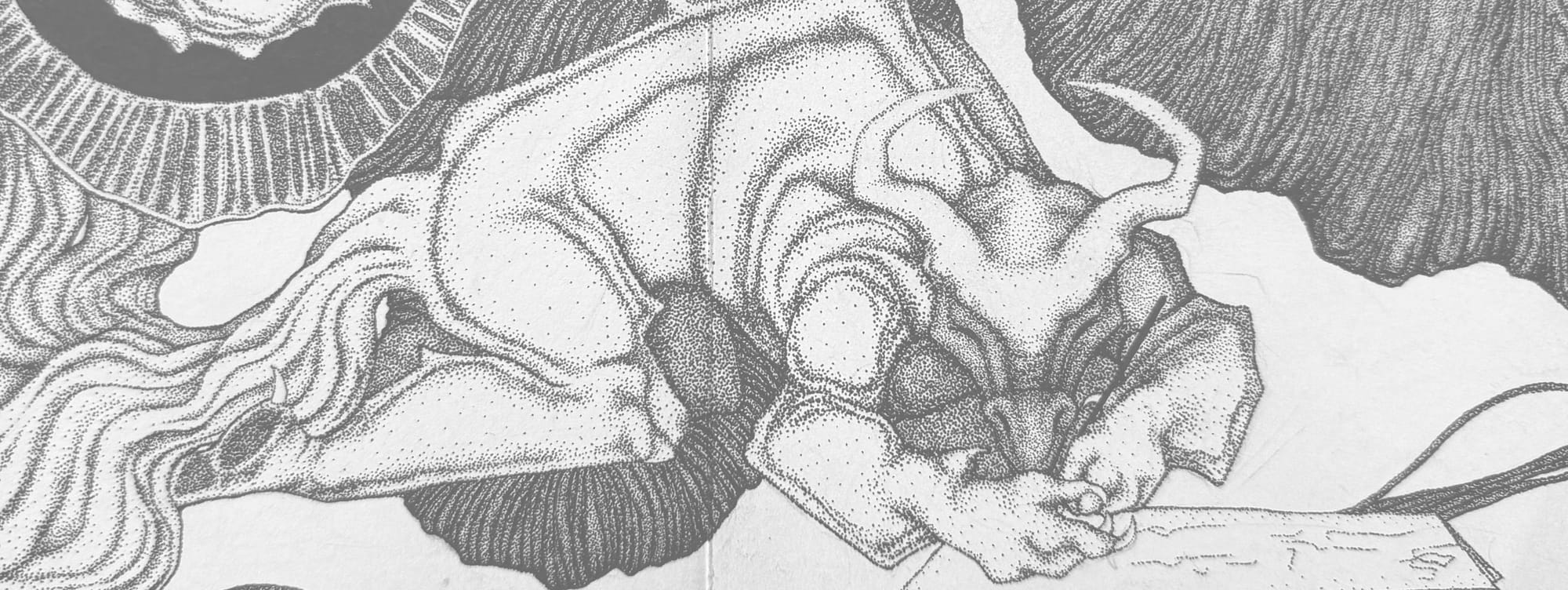
"The Writing Dragon" is part of a very long, in shape and time, pointillism project I’ve been working on. More to come.